
Understanding the Difference Between a BAL Report and a BMP
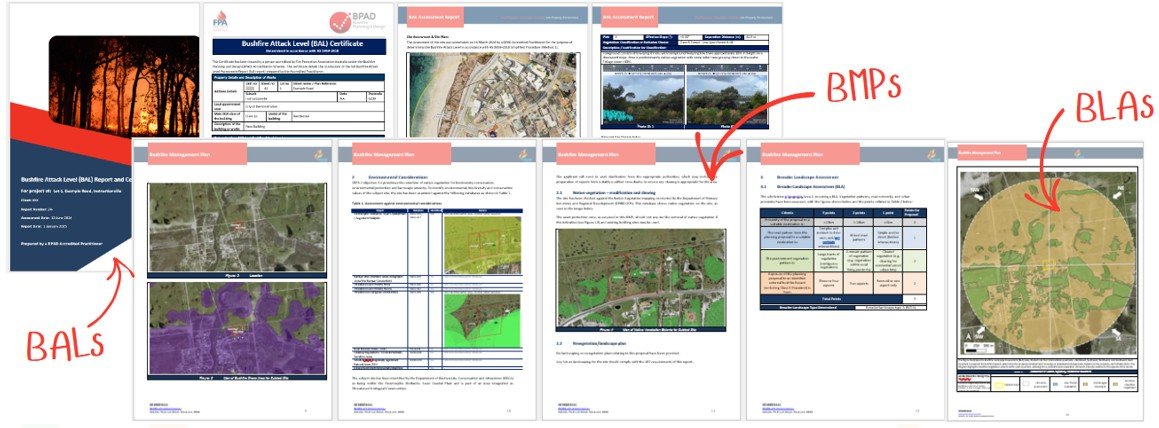
BAL Assessment vs Bushfire Management Plan (BMP): What's the Difference?
If you're planning to build or develop in a bushfire-prone area, you've likely come across the terms Bushfire Attack Level (BAL) assessment and Bushfire Management Plan (BMP). While both assess bushfire risk, they serve different purposes and are required under different circumstances.
Understanding which report you need can save time, reduce delays in the planning process, and ensure your project meets the relevant regulatory requirements.
What is a Bushfire Attack Level (BAL) Assessment?
A Bushfire Attack Level (BAL) assessment is a site-specific assessment that determines the potential level of bushfire exposure for a proposed building or development.
The assessment considers factors including:
The type and classification of surrounding vegetation
The distance between vegetation and the proposed building
The slope of the land beneath the vegetation
These factors influence how a bushfire may behave and the level of exposure to ember attack, radiant heat and direct flame contact.
The outcome is a BAL rating, which informs the construction requirements under Australian Standard AS 3959.
For many residential projects, particularly on smaller lots where only a building permit is required, a BAL assessment is often all that is needed.
What is a Bushfire Management Plan (BMP)?
A Bushfire Management Plan (BMP) is a more comprehensive assessment that incorporates a BAL assessment while also demonstrating how a proposed development complies with the Bushfire Protection Criteria of State Planning Policy 3.7: Planning in Bushfire Prone Areas and the associated Guidelines.
Rather than simply determining a BAL rating, a BMP evaluates the broader bushfire risk and identifies the measures required to achieve an acceptable level of safety for the proposed development.
This may include considerations such as:
Ongoing vegetation management and Asset Protection Zones (APZs)
Emergency access and egress
Water supply for firefighting
Driveway requirements
A BMP provides planning authorities with the information they need to determine whether a development can proceed safely within a bushfire-prone area.
When is a BMP Required?
While requirements vary depending on your local government and the nature of the proposal, a Bushfire Management Plan is commonly required where the property is one or more of the below:
Located within a designated bushfire-prone area
Exceeds 1,100 m² in lot size
Does not have access to a reticulated (mains) water supply
Requires vegetation clearing as part of the development to achieve BAL-29 or below.
Requires planning approval from the local government or the Western Australian Planning Commission
If any of these circumstances apply, your planning application may require a BMP rather than a standalone BAL assessment.
Subdivisions Require Additional Assessment
For subdivision proposals, additional bushfire planning considerations apply.
In these cases, a Broader Landscape Assessment (BLA) is typically required as part of the Bushfire Management Plan.
A BLA examines the wider surrounding landscape to determine whether increased development is appropriate from a bushfire safety perspective. It considers factors such as:
Surrounding vegetation and topography
Road networks and evacuation routes
Nearby safer places or refuge locations
Landscape connectivity and fire behaviour
Exposure to surrounding bushfire hazards
This broader assessment helps ensure that subdivision proposals do not increase bushfire risk for future occupants.
Which Report Do You Need?
The type of assessment required depends on several factors, including:
The size of your lot
The location of your property
The type of development proposed
Whether planning approval is required
Local government or State planning requirements
While many projects only require a BAL assessment, more complex developments often require a Bushfire Management Plan to satisfy planning legislation.
It's also important to note that your local City or Shire has the discretion to request additional bushfire information, even where a property would not ordinarily require one. If this occurs, our team can prepare the necessary documentation and guide you through the process.
We're Here to Help
Determining which bushfire assessment you need can be confusing, particularly when planning requirements differ between developments.
Our experienced team can assess your proposal, advise which report is required, and prepare the documentation needed to support your building or planning application.
Whether you need a straightforward BAL assessment or a comprehensive Bushfire Management Plan, we're here to help you navigate the process with confidence